
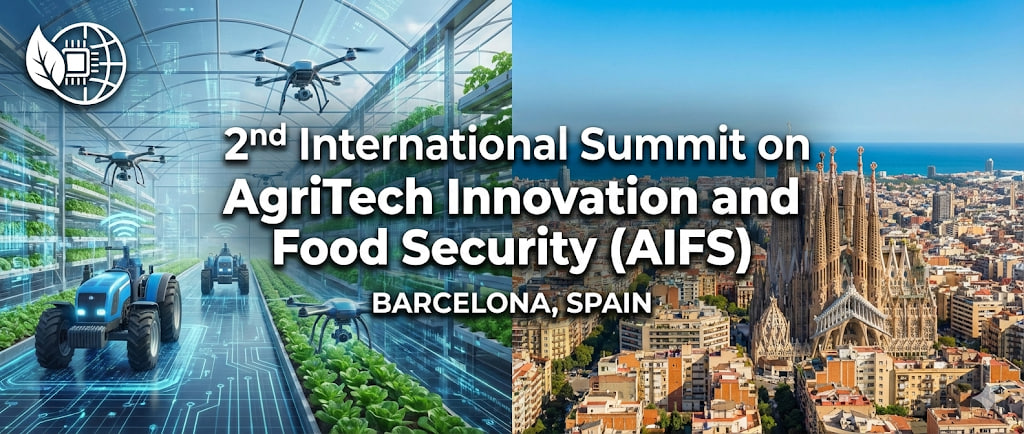
2nd International Summit on AgriTech Innovation and Food Security (AIFS)
Day 1: Arrival & Networking
Day 2: Core Technical Sessions
09:00 – 09:15 Opening Ceremony Welcome remarks by the Conference Chair. Overview of the current state of Intelligent Corrosion Control.
09:15 – 10:00 Keynote Address 1
Topic: AI & Machine Learning in Corrosion Prediction
10:00 – 11:00 Technical Track A
Theme: Smart Coatings & Self-Healing Materials
(3 presentations, 20 mins each)
11:00 – 11:20 Coffee & Networking Break Short break for refreshments and checking vendor booths.
11:20 – 12:20 Technical Track B
Theme: IoT, Digital Twins, and Remote Monitoring
(3 presentations, 20 mins each)
12:20 – 13:00 Panel Discussion & Closing
Topic: Overcoming Barriers to Digital Adoption
Panelists take questions from the floor. Day 2 formal adjournment at 1:00 PM.
Day 3: Cultural & Social Day (Optional)
Additional fee applies
Conference Objective:
-
-
Accelerate Digital Adoption: To accelerate the integration of AI, IoT, and robotics into traditional farming practices to increase yield and efficiency.
-
Enhance Food Security: To discuss actionable strategies for achieving Zero Hunger (SDG 2) by reducing post-harvest losses and improving distribution networks.
-
Promote Climate Resilience: To explore Climate-Smart Agriculture (CSA) techniques that help farmers adapt to extreme weather, drought, and changing soil conditions.
-
Bridge the Investment Gap: To connect AgTech startups with venture capitalists, angel investors, and development banks to secure funding for scalable solutions.
-
Optimize Supply Chains: To examine how blockchain and data analytics can create transparent, traceable, and efficient farm-to-fork supply chains.
-
Empower Smallholders: To identify technologies that are affordable and accessible to smallholder farmers, ensuring inclusive growth in the sector.
-
Formulate Policy: To bring together policymakers and industry leaders to draft regulatory frameworks that encourage innovation while ensuring food safety.
-
Advance Sustainability: To promote regenerative agricultural practices that restore soil health, manage water usage efficiently, and reduce carbon footprints.
-
Explore Alternative Proteins: To analyze the market potential and technical challenges of vertical farming, lab-grown meat, and plant-based alternatives.
-
Facilitate Knowledge Transfer: To create a pathway for transferring academic research and lab innovations directly to the fields where they are needed most.
-
Who Should Attend?
-
AgTech Founders & CEOs: Leaders of startups developing drones, sensors, farm management software, and biotechnology.
-
Agricultural Policymakers: Government officials and regulators responsible for food standards, agricultural subsidies, and trade policies.
-
Venture Capitalists & Investors: Fund managers looking for high-impact investment opportunities in the GreenTech and AgriFood sectors.
-
Farmers & Producers: Large-scale commercial farmers and cooperatives seeking new tools to optimize their operations and reduce costs.
-
Agronomists & Researchers: Scientists from universities and research institutes studying crop genetics, soil health, and pest management.
-
Supply Chain & Logistics Managers: Professionals from food retail and distribution companies focused on cold chain integrity and traceability.
-
NGOs & Development Agencies: Representatives from organizations like the FAO, World Bank, and local non-profits working on rural development.
-
Data Scientists & Engineers: Technical experts specializing in big data, machine learning, and remote sensing applications for agriculture.
-
Sustainability Officers: Corporate leaders from major food and beverage companies driving ESG (Environmental, Social, and Governance) goals.
-
Equipment Manufacturers (OEMs): Representatives from tractor, irrigation, and hardware companies looking to integrate smart technology into their machinery.
Why Attend this Event?
-
Access Cutting-Edge Innovations: Be the first to see the latest breakthroughs in precision agriculture, from AI-driven harvesting robots to next-gen soil sensors, before they hit the mass market.
-
Secure Funding & Investment: A dedicated platform for startups to pitch directly to active Venture Capitalists and Angel Investors looking for the next “unicorn” in the AgTech space.
-
Global Networking Opportunities: Connect with a diverse mix of 500+ attendees, including industry CEOs, government ministers, and academic leaders from over 30 countries.
-
Master Climate-Smart Strategies: Learn practical, field-tested methods for adapting to climate change, ensuring your agricultural operations remain resilient against drought and extreme weather.
-
Influence Policy & Regulation: Participate in high-level roundtable discussions that shape the future of agricultural policy, food safety standards, and trade regulations.
-
Hands-On Learning: Go beyond theory with interactive workshops on blockchain traceability and vertical farming, plus optional site visits to active “Smart Farms.”
-
Identify New Market Trends: Gain insider knowledge on emerging consumer demands, such as the shift toward plant-based proteins and sustainable sourcing, to stay ahead of the competition.
-
Bridge the Digital Gap: Understand exactly how to implement digital tools (IoT, Big Data) in your operations to reduce costs and increase yield—without needing a PhD in computer science.
-
Find Strategic Partners: Whether you are looking for a technology vendor, a research partner, or a distributor, this summit brings the entire supply chain under one roof.
-
Contribute to Zero Hunger: Join a mission-driven community dedicated to solving the world’s most pressing challenge—feeding a growing population sustainably and equitably.
Benefits of Attendance:
-
Gain a Competitive Advantage: uncover the latest disruptive technologies and strategies that your competitors are not yet using, allowing you to position your organization as a market leader.
-
Expand Your Professional Network: Build lasting relationships with a curated group of 500+ stakeholders, including government officials, tech innovators, and potential business partners.
-
Access to Investment Capital: For startups and entrepreneurs, this is a prime opportunity to present your business case directly to active investors specifically looking for AgriTech opportunities.
-
Enhanced Decision-Making: Equip yourself with data-driven insights and global market forecasts that will help you make smarter, lower-risk strategic decisions for the coming year.
-
Policy & Compliance Readiness: Get ahead of regulatory changes by hearing directly from policymakers about upcoming food safety standards, environmental regulations, and trade agreements.
-
Operational Efficiency: Learn specific, actionable techniques to reduce waste, lower energy costs, and optimize resource usage in your farming or supply chain operations.
-
Global Perspective: Step out of your local bubble and understand how different regions (Asia, Africa, Americas) are tackling food security, offering fresh solutions you can adapt locally.
-
Direct Interaction with Experts: Move beyond reading reports—ask questions and get personalized advice from world-renowned agronomists and tech developers during Q&A sessions and workshops.
-
Talent Scouting: Connect with bright researchers, PhD students, and skilled professionals who could be valuable additions to your own team.
-
Inspiration & Motivation: Reignite your passion for the industry by engaging with success stories and visionary ideas that demonstrate the positive impact of your work on global food security.
Topics of Interest for Papers:
Category A: Precision Agriculture & Digital Farming
-
AI & Machine Learning Applications in Crop Monitoring: Predictive models for yield estimation and disease detection.
-
IoT & Sensor Networks: Development of low-cost soil moisture, nutrient, and weather sensors.
-
Robotics & Autonomous Systems: Advances in autonomous tractors, drone-assisted spraying, and robotic harvesting.
-
Big Data Analytics in Agriculture: Managing and interpreting large datasets for farm decision support systems.
-
Digital Twins in Agriculture: Creating virtual replicas of farms to simulate and optimize production cycles.
Category B: Sustainable & Climate-Smart Practices
-
Climate-Resilient Crop Varieties: Genetic innovations for drought, saline, and heat tolerance.
-
Regenerative Agriculture Techniques: Technologies supporting soil carbon sequestration and biodiversity restoration.
-
Water Management Innovations: Smart irrigation systems and wastewater recycling in agriculture.
-
Bio-pesticides & Integrated Pest Management: Reducing chemical dependency through biological control agents.
-
Renewable Energy in Farming: Agrivoltaics (solar farming) and biomass energy production on farms.
Category C: Food Security & Supply Chain
-
Blockchain for Food Traceability: Ensuring transparency and safety from farm to fork.
-
Cold Chain Logistics Technologies: Smart packaging and monitoring to reduce post-harvest losses.
-
Urban & Vertical Farming: Engineering challenges and economic viability of controlled environment agriculture (CEA).
-
Alternative Proteins: Production technologies for plant-based meat, insect protein, and cellular agriculture.
-
Food Safety Diagnostics: Rapid detection technologies for pathogens and contaminants in the supply chain.
Category D: Policy, Economics & Society
-
Adoption Barriers for Smallholder Farmers: Socio-economic studies on technology accessibility in developing nations.
-
Fintech Solutions for Agriculture: Digital credit scoring, micro-insurance, and mobile payment platforms for farmers.
-
Data Privacy & Ownership: Legal frameworks and ethical considerations in agricultural data management.
-
The Role of Women in AgriTech: Strategies for closing the gender gap in agricultural technology adoption.
-
Policy Frameworks for Gene Editing: Regulatory landscapes for CRISPR and GMO technologies in food production.


